Lie, deny, sigh, these have been my social coping skills. Trying to figure out a better way to go through life as a prosopagnosic, aka, faceblind person.
Brad Duchaine is the researcher I did testing with when he was at the University College of London.
Please click on titel to take you to the Minnesota Daily website where this article was published.
University lab looking to crack face blindness
The Yonas Visual Perception Lab is seeking treatments and new methods of diagnosis.
ByAnne Millerbernd [3] October 24, 2013 (3 weeks ago)
Stephanie Chase used to recognize some of her Valleyfair coworkers by their ponytails. She thought nothing of it until a male coworker had to consistently remind her of who he was.
Then Chase realized something wasn’t right. She then happened upon a description of prosopagnosia, also known as face blindness, and she discovered she has the disorder.
People with face blindness have difficulty recognizing faces, sometimes even their own. A team of University researchers is working to find the best methods of diagnoses and treatments for the disorder.
Albert Yonas leads the the Yonas Visual Perception Lab, where Chase is a research assistant.
“Most people don’t know the problem exists; some people grow up to think everybody’s got the problem,” Yonas said. “Some people just have unhappy lives,”
He said about 2 to 2.5 percent of people worldwide have face blindness.
Vanessa Adamson, the Yonas lab’s manager, said the severity of face blindness varies on a case-by-case basis. Someone could forget a face moments after it’s gone or struggle to differentiate any two faces. In extreme cases, she said, someone with face blindness can look at a picture of themselves without recognizing it’s them.
Chase said people sometimes think she’s “snubbing” them when she doesn’t recognize them and she hesitates to tell others about her face blindness.
“I’ll totally remember a conversation I had with them, just not their face,” she said. “I think that’s a hard distinction for people to make, especially at first.”
There are two different types of face blindness, acquired and developed, Yonas said. Generally, those with acquired face blindness have experienced brain damage and lost the ability to recognize familiar faces, he said.
The Yonas Lab is focusing its research on developmental face blindness,
specifically in children.
Developmental face blindness is likely caused by development issues in the region of the brain responsible for face recognition, said University research fellow Kirsten Dalrymple.
“We have machinery in our brains that is allocated for face recognition alone,” she said. “If that machinery doesn’t develop, you’re not going to be able to do that specialized process.”
In the Yonas Lab, researchers test children for face blindness by asking them to memorize what three pictures of faces look like, Dalrymple said.
Researchers then present the children with another set of three faces, one from the previous set, and ask them to identify the face they’ve seen before.
But face blindness is a difficult disorder to identify, even for those who have it, Dalrymple said. Many people with the disorder use cues like hair, skin color and clothes instead of faces to remember people.
Those with developmental face blindness often spend their lives unaware that they have the disorder, Dalrymple said. They think everyone grows up “learning who people are” instead of being able to identify their faces, she said.
There are indications that face blindness is a genetic disorder, Dalrymple said, but it hasn’t been linked to one gene yet.
Brad Duchaine, an associate professor in the Department of Psychological and Brain Sciences at Dartmouth, is also researching face blindness, but he focuses on its acquired form.
Duchaine said there are two different stages in face processing — the stage where a face is seen and the stage where it is remembered and identified as a person.
He believes most instances of face blindness are caused by visual perception problems, though this can be difficult to recognize for people with the
disorder, he said.
“It feels like a memory problem because when you’re looking at a face for the first time, you have no idea what it should be looking like,” Duchaine said. “But then when you fail to recognize it again, it feels like a memory
failure.”
He said about 2 to 2.5 percent of people worldwide have face blindness.
Vanessa Adamson, the Yonas lab’s manager, said the severity of face blindness varies on a case-by-case basis. Someone could forget a face moments after it’s gone or struggle to differentiate any two faces. In extreme cases, she said, someone with face blindness can look at a picture of themselves without recognizing it’s them.
Chase said people sometimes think she’s “snubbing” them when she doesn’t recognize them and she hesitates to tell others about her face blindness.
“I’ll totally remember a conversation I had with them, just not their face,” she said. “I think that’s a hard distinction for people to make, especially at first.”
There are two different types of face blindness, acquired and developed, Yonas said. Generally, those with acquired face blindness have experienced brain damage and lost the ability to recognize familiar faces, he said.
The Yonas Lab is focusing its research on developmental face blindness,
specifically in children.
Developmental face blindness is likely caused by development issues in the region of the brain responsible for face recognition, said University research fellow Kirsten Dalrymple.
“We have machinery in our brains that is allocated for face recognition alone,” she said. “If that machinery doesn’t develop, you’re not going to be able to do that specialized process.”
In the Yonas Lab, researchers test children for face blindness by asking them to memorize what three pictures of faces look like, Dalrymple said.
Researchers then present the children with another set of three faces, one from the previous set, and ask them to identify the face they’ve seen before.
But face blindness is a difficult disorder to identify, even for those who have it, Dalrymple said. Many people with the disorder use cues like hair, skin color and clothes instead of faces to remember people.
Those with developmental face blindness often spend their lives unaware that they have the disorder, Dalrymple said. They think everyone grows up “learning who people are” instead of being able to identify their faces, she said.
There are indications that face blindness is a genetic disorder, Dalrymple said, but it hasn’t been linked to one gene yet.
Brad Duchaine, an associate professor in the Department of Psychological and Brain Sciences at Dartmouth, is also researching face blindness, but he focuses on its acquired form.
Duchaine said there are two different stages in face processing — the stage where a face is seen and the stage where it is remembered and identified as a person.
He believes most instances of face blindness are caused by visual perception problems, though this can be difficult to recognize for people with the
disorder, he said.
“It feels like a memory problem because when you’re looking at a face for the first time, you have no idea what it should be looking like,” Duchaine said. “But then when you fail to recognize it again, it feels like a memory
failure.”
Prosopagnosia is a condition that can make it impossible to recognize the faces of others, from friends to movie characters to parents. To varying degrees, it affects about two percent of people.
Deux hommes en pied by Edgar Degas (Renaud Camus/flickr)Jacob Hodes lies on the couch watching old reruns on television. It’s his roommate Sonny Singh’s turn to cook dinner tonight, and their Brooklyn apartment fills with the aroma of Indian food.
As Singh bangs around in the kitchen, Hodes talks about a party he attended recently. “CUNY J-School parties are the worst, I don’t recognize anyone,” he says.
Then he guffaws and glances back at Singh. “I don’t think I could ever miss you on the street, man.”
Singh runs his fingers through his long beard. “Yeah, the turban makes it difficult to forget, huh? Unless, of course it was Sikh Day Parade.”
There’s a knock on the door and Singh lets in a young woman.
“Hey,” she says.
Hodes pretends not to notice. He sinks deeper into the couch and keeps his eyes on the television. She walks into the kitchen, unaffected, and chats animatedly with Singh.
Hodes’ other roommates come out and embrace the woman. “I think I’m supposed to know who she is,” Hodes whispers once she’s out of sight. “ But I don’t recognize her at all.”
Prosopagnosia, or “face blindness,” the disorder that has plagued Hodes since he was a child, is the inability to recognize faces that should be familiar. Some patients’ impairment influences only the recognition of faces; others find their deficit extends to the recognition of other objects such as cars and animals.
While anyone can have trouble recognizing faces and names, prosopagnosics can’t even identify their own parents and relatives. They rely on non-facial information like hair color, gait, and tone of voice to distinguish people.
Prosopagnosics often complain that they have trouble following movies or television shows, because they cannot recognize characters and keep up with the plot.
Many also report problems with other aspects of face processing: They find it difficult to judge age or gender, recognize emotional expressions, or follow the direction of a person’s gaze. A substantial portion report navigational difficulties, because their sense of direction is impaired.
Though researchers have sought cures, no therapies have demonstrated lasting improvements.
“While there have been transient benefits, there has been nothing else that has made a real impact,” says Garga Chatterjee, currently pursuing doctoral research in prosopagnosia at Harvard.
There are only about 100 documented cases of prosopagnosia in the worldwide medical literature. Yet scientists at the Prosopagnosia Research Centers at Dartmouth College, Harvard University and University College London are questioning whether the condition is actually that uncommon. “2.5 percent of the world’s population has the disorder. That’s one person in every 50. That is not rare at all,” Chatterjee says.
In 2004, researchers at the Institute for Human Genetics in Germany gave 576 biology students a prosopagnosia screening questionnaire and found that nearly two percent reported face blindness symptoms. Scientists at the Prosopagnosia Center in 2006 also reported, after testing 1600 individuals, that about two percent of the general population may have prosopagnosia.
***
In 2007, Glenn Alperin was flying from Atlanta to Boston. “I was reading a newspaper when this man came up to me and shook my hand. He went down the aisle shaking hands with all of the passengers,” Alperin recalls.
“I waited until he was at a safe distance and turned to the man sitting next to me and asked him who that was. The guy looked at me, horrified and said, ‘That was Jimmy Carter!’”
Dressed in a fishing hat and an oversized green jacket, Alperin has just finished his session at a day treatment center in Cambridge, Massachusetts
He makes his way to the subway station, carefully deliberating which train to take to Brookline, where he will tutor his first student of the day.
“I don’t look at people until I am spoken to,” says Alperin, who’s had prosopagnosia since infancy. He provides an interesting analogy: “Most people take a picture with their brain and store and develop the film. I take the picture, but throw the film in the trash immediately.”
Alperin’s mother Peggy recalls the time they discovered the disorder. “I remember we went somewhere and my eldest son’s voice had just started to crack and Glenn was having trouble telling his brothers apart,” she says. She then did some research, and doctors confirmed that Alperin did in fact suffer from prosopagnosia.
Peggy did her best to support Alperin after they diagnosed the disorder. She put alarms all over the house and if reporters ever visited his school, she wouldn’t allow his photograph to appear in the newspaper. She constantly fears that people may take advantage of his condition.
“I can’t say anything now, because he is a full grown adult, but he tutors and goes to people’s houses he doesn’t even know. God forbid if something were to happen, he wouldn’t even be able to identify the person,” she says. “I am a gardener and it is only now, at the age of 63, that I have allowed my work to appear in shows. When Glenn was a child, I was so concerned for his safety, I never showed my work to anyone.”
Researchers say prosopagnosia isn’t a unitary disorder, meaning that it is different for each patient. “Each prosopagnosic’s description of their experiences will be different,” Chatterjee says.
Most patients develop strategies for tackling the problem. They may note carefully the clothes someone is wearing, ask relatives to always wear a particular distinctive item, or learn how to initiate and maintain conversations while they figure out whom they are talking to. But such strategies aren’t completely effective.
Alperin’s mother would often test him as a child, hoping that would sharpen his mind. “My mother would keep changing her hairstyle and it would frustrate me because I couldn’t recognize her,” he says. “But now that both of us are older and she knows there’s no real cure for my disorder, she just ties her hair at the nape of her neck with one highlight running through her bun and that’s how I can identify her.”
Alperin grew up on Boston’s North Shore with two elder brothers who did their best to help him out. But with their similar features and flaming red hair he still had trouble telling them apart. Yet, he says, briskly walking through Brookline, his family was incredibly supportive.
“I would tell him, at his wedding, I would have to get the word ‘wife’ monogrammed on his wife’s dress, so he wouldn’t kiss the wrong girl,” Peggy recalls, laughing. “I had to prepare him to deal with the disorder and I wanted him to have a sense of humor about it.”
His father, who died when Glenn was 16, spoke little. “He never mentioned anything about my disorder,” he says. “It was only later that I learned that he was worried I would forget him. But I could never do that.”
Alperin rates the severity of his prosopagnosia a 9 out of 10. He finds it difficult even to recognize himself in a mirror. “I don’t like to take the time to see what I actually look like now, because I don’t care,” he says. At age 34, he is tall and lanky and keeps a long, red beard he constantly plays with.
“That drives me crazy,” his mother says. She has been trying to get him to shave off his beard for a while now. “Although I get mad at him, I feel that the long beard is the only way he can recognize himself. His coordination is not great, so shaving too, must be trouble for him.”
The stranger a person looks, the more Alperin is attracted to him or her.
“I can recognize people that wear outrageous clothes or have different-colored hair a lot easier than those that blend into the crowd,” he says. “I like to believe I am attracted to people’s personalities. I can’t be attracted to the way they look.”
While some prosopagnosics feel socially inept, Alperin tries to be outgoing. He stops to orders a cinnamon roll and strawberry flavored milk at the Dunkin Donuts in Brookline, which he frequents regularly. “They all know me here, but I don’t know them,” he jokes. When the cashier asks if he wants anything else, he grins, “Yes, a million dollars would be nice, thank you.” He’s fighting the most frustrating consequence of prosopagnosia: The tendency to drive someone into isolation.
“It’s far easier for me to be alone than to try and navigate my way through a sea of faces I will never be able to comprehend,” he says. “Imagine walking into a place where everyone looks like identical twins. That’s what I have to go through at social gatherings.” Because prosopagnosics are prone to depression, Alperin attends a day treatment program, which helps him overcome his unhappiness. Wolfing down his cinnamon rolls, he describes his treatment at the center.
“The sessions help participants through mental health issues and provide survival techniques. It is helpful, because everyone that attends shares the problems they have together.”
Social anxiety disorders and depression can ensue for prosopagnosics, because the disorder has such an impact on social groups and the patient’s interaction with society.
“The Internet is probably the best thing that happened to prosopagnosics,” Alperin says. “You can communicate with someone, build relationships, and maintain them without ever having to see their face or recognize them.”
Yet, lack of direct social interaction also led him down a bad path.
“I developed an online gambling problem when I was in college,” he says. “I specifically remember a telephone conversation with my mother when I was [in college] about a telephone bill which was off the wall, which effectively launched my gambling problem. It is still a problem, I don’t know if I will ever get over it.”
Alperin recognizes that gambling is dangerous. “Intellectually I know it does me far more harm than good, but addictions are rarely, if ever about applying logic.”
The need for social interaction is what pushed him to become a tutor. “It’s difficult to interact with someone on a one on one basis and that’s why I wanted to pose that challenge to myself,” he says.
Walking through residential Brookline, Alperin practices something he learned from Nancy Mindick’s book, Understanding Facial Recognition Difficulties in Children. He walks with his head down, and when he does look up, he avoids eye contact with passers by. “Because I have such a hard time picking up on non-verbal communication, I appear distracted.” He changes his expression and brings a distant look into his eyes. “This way, if someone wants to speak to me, they have to make the effort to approach me.”
“I am attentive all the time, but I still get confused,” he says, walking towards his student’s house. He pauses for a moment “I don’t know whether it’s this house, or the one next to it.” He walks up to one, but quickly changes his mind and rings the bell next door.
Alperin doesn’t feel awkward talking about his disorder with people he’s just met, he says. It’s not like he could hide it anyway. “Prosopagnosia is something that affects my interaction and my life on a daily basis, so I’m rather unabashed about my condition,” he says.
Alperin has been tutoring 14-year-old Avi Ber in math for the past three months and as a coach, he appears patient and gentle.
“Are you confident?” he asks when she tells him about an upcoming math project.
“Yeah, I think,” she says hesitatingly.
He glances at her briefly and smiles. “Not as confident as it sounds.”
Avi, a sophomore at Brookline High, says Alperin’s tutoring has helped her perform better. “He makes things very easy to understand,” she says. Alperin says his disorder has not harmed the student-tutor relationship. “I didn’t know what it was,” Avi says. “So I guess that’s another new thing I learned.”
***
Though researchers can trace face recognition problems after brain injury as far back as the 19th century, prosopagnosia was first identified as a separate neuropsychological problem by German neurologist Joachim Bodamer in 1947. While studying the brain injuries of World War II veterans, he came across two prosopagnosics.
One was unable to combine features to see a whole face; the other couldn’t recognize facial expressions. Though Bodamer was investigating a condition resulting from acute brain damage, contemporary researchers have found that a congenital or developmental type also exists: some patients are born with prosopagnosia.
Glenn Alperin started showing face recognition problems after a fall from his crib at 16 months. “I didn’t realize it so much when I was a child, but I was constantly confused,” he says.
Acquired prosopagnosia, when the patient suffers brain damage from an injury or stroke is better known because patients have a clear sense of their impairment and know what they were like before they suffered the brain injury. In developmental prosopagnosia, which is genetic, the impairment is less apparent to the patient.
“I feel like Glenn not knowing what life was like without the disorder is a blessing and a curse,” Alperin’s mother says. “He would also be scared to cure it, because he doesn’t know what life is like without it.”
Deficits commonly associated with prosopagnosia include loss of color vision and the inability to find one’s way about. When the Alperins took skiing trips as a family, Glenn couldn’t find his way from the parking lot to the lodge.
“But, when he was skiing, he made his way through the mountains with no trouble at all. I realized that it was the snow. All that white took away all that noise in his head,” says Peggy. Similarly, Peggy says Alperin prefers the night, because it is quieter and navigation becomes easier for him. “I wish someone [would invent] glasses for Glenn, where he could see the world in black and white. It would make his life a lot easier,” she says.
***
“It’s not that I don’t know everyone. The problem is I don’t know whom I know,” says Hodes, talking about the party he went to recently. “I was looking for the host and she causes me trouble,” he says. “She keeps changing her hairstyle.”
He glanced around the room for a while before the hostess found him. He got himself a drink and started talking to a photographer sitting next to him.
“Did you also go to CUNY?” Hodes asks.
“Yeah, yeah I did,” the man replied.
Hodes had struck gold. “Wait a minute, you teach there now don’t you?” he asked eagerly.
“Yeah.”
“You teach the photo class, you’re like an assistant? You taught my class,” Hodes said.
“We had many interactions and I ought to have known him, but thankfully he didn’t recognize me,” Hodes says later.
A recent CUNY journalism graduate, he’s become a prosopagnosia celebrity since appearing on 60 Minutes in August 2012.
Hodes doesn’t think it necessary to tell people about his disorder right away. “It would appear like I was self absorbed,” he says.
Now most of his classmates and professors are aware of his face blindness—a mixed blessing, since people started asking him jokingly, “Do you recognize me?”
Though he has lived with prosopagnosia since birth, Hodes wasn’t diagnosed until he was 19, when he was a student at Swarthmore College. His parents were going through a divorce, so he took advantage of the school’s free therapy. In addition to talking about his family, he told the counselor about his trouble recognizing people. “That’s when they told me that I may be suffering from the disorder,” he says.
He went home that night and read up on prosopagnosia. Bill Choisser who suffered from it for years, was sharing his experiences on a blog. “It was like every movie cliché happened,” Hodes recalls. “I was reading Bill’s work and crying because years of repressed experiences finally made sense.”
He signed up for testing in Boston at the Prosopagnosia Research Center. A functional MRI showed nothing wrong with his brain, yet he couldn’t recognize faces on tests. “I can recognize horses, houses or even guns, but when it comes to faces, nothing,” he says.
When he broke the news to his mother, she didn’t seem surprised; she had noticed the problem when he was a child.
“I was like, ‘Mom, what the hell? Why didn’t you ever point it out?’” he says. “I remember I was always confused as a kid because all of us on the soccer team had that same stupid buzz cut and wore that same uniform three times a week.”
Unlike Alperin, who thinks his prosopagnosia results from a fall, Hodes suffers from congenital prosopagnosia, which appears to run in families and probably results from a genetic mutation or deletion.
“My dad is in his 50s and when I told him about the disorder, we found out he suffers from prosopagnosia as well. A lifetime of experiences suddenly made sense. I can imaging how difficult it must have been for him, because he used be a labor organizer,” Hodes says.
***
It’s a Sunday evening and it’s Hodes’s turn to cook dinner at home. His roommate Heidi Chua Schwa is in the kitchen making tea.
Hodes has lived in his Brooklyn apartment for five years. Because he doesn’t like to talk about his condition, he initially confused his roommates when he didn’t acknowledge them.
“He completely ignored me on the street one day and I was like ‘what?’” says Schwa, laughing.
Hodes smiles shyly. “Yeah, but then I told you about it and it was okay.”
He believes he needs to meet someone at least 30 times before he can recognize him or her. Social networking, however, is helping him cope. “Facebook actually really helps a lot, because I can see what the person looks like if I haven’t met them in a few months.”
Doctors and researchers say there’s no cure for the disorder, but they’ve made progress in identifying the areas of the brain that could be responsible for face blindness. In October 2012, doctors at Stanford performed a clinical procedure on a patient with electrodes temporarily implanted in his brain. They were able to find two nerve clusters that were critical for face perception. “We stimulated the region of the brain responsible for seizures,” says Josef Parvizi, assistant professor of neurology at Stanford. “It caused the patient’s vision of faces to distort, leaving the perception of inanimate objects and other body parts the same.”
While the study doesn’t provide any options for treatment, it helps distinguish the part of the brain responsible for face recognition. “I wouldn’t call it groundbreaking, but it is important because causelogy has been established for prosopagnosia, which other studies have not been able to do,” Parvizi says. Connecticut Muffin at Lafayette and Fulton in Brooklyn is one of Hodes’ regular haunts. He sits with one leg propped against the armrest of the chair, sipping chai.
“I like traveling,” he says. “I went to Sri Lanka to visit this girl I was dating, it was really beautiful.”
Does it ever scare him, traveling and maintaining a relationship given his disorder? He smiles “No, it doesn’t. But this girl that I was dating, she kept changing her hairstyle and it drove me nuts. It was like waking up with a different person every day.”
It does cause him problems as a journalist sometimes, though. He describes an interview he did while reporting on factory workers in the Bronx. “I’m taking really detailed notes and everything—suddenly his brother comes over. I look at them, same features, same hair and I think, ‘I’m totally screwed.’”
When he returned for a follow-up interview he asked the family members their names again, checking them against his notes. If he doesn’t recognize a source, he asks for the spelling of her name.
Like other prosopagnosics, Hodes complains that following the plot of a movie or television show is difficult. He watched Amour recently and didn’t find it difficult to follow because there were so few characters. But back on his favorite spot on the couch, James Cameron’s Avatar confounds him within the first two minutes when an actor morphs into a cartoonish character.
“Wait, is this the same guy that was looking at the dead body?” he asks baffled. He pauses and rewinds, starting the movie over three times.
He throws his hands in the air, exasperated, “How can you tell if he was the same guy in the wheelchair? Can you tell them apart? Man, you have some superpower.”
This was in the comment section of the last post, but I am reposting it to make sure everyone sees it. A Prosopagnosic study being conducted, in need of participants. Time to do your part. It helps us all to know more about our interactions with others.
Hello, my name is Trish Devine, and I am a professor at the University of Wisconsin-Madison. I study social perception, and I am conducting a study with people who have prosopagnosia, examining how different social categories are perceived via the face versus other cues. The study only takes about 15 minutes. Because prosopagnosia is such a rare condition, we need as much help as we can get finding people to be in our study. If you wouldn’t mind posting a link to our experiment (below) on your blog, we would really appreciate it.
People with prosopagnosia can provide a unique and essential perspective, granting them the ability to contribute greatly to our understanding of social perception. If you have any questions about the study or anything else, feel free to email me at iplab@psych.wisc.edu.
Trish Devine
Department of Psychology
University of Wisconsin – Madison
This research is being conducted by researchers at the University of Wisconsin – Madison, and has been reviewed and approved by the Institutional Review Board. If you have any questions or comments, you can reply to this email, contact the principle investigator of the Interpersonal Perceptions Lab at iplab@psych.wisc.edu.
There are many pairs (or sometimes more than two) of people who I confuse with each other. Much of the time, its a similar hairstyle, hairline, or facial hair arrangement. Here is the first installment of People I Can't Tell Apart. When I see one of them speaking on television with the sound turned down, I have no idea which one it is, and often mistake one for the other.
This is one of my favorite First person accounts of life with Prosopagnosia. I relish its straightforwardness. It was published in the British Journal of Medicine by a doctor willing to tell his story.
1. David R Fine, consultant gastroenterologist, Southampton University Hospitals NHS Trust
1. davidrfine@gmail.com
He is a distinguished colleague and I am proud we are on first name terms: had I met him at the conference rather than the airport I would not have walked past. I was embarrassed, so my wife explained my problem, and his reply was unusual: “You must write a review for the BMJ so that others can understand your problem and benefit from your experience. Accounts of disability and how people cope are uplifting and help even those not afflicted.”
I have severe inherited (developmental) prosopagnosia, or face blindness. The term prosopagnosia was coined in 1947, but it has been widely recognised outside the context of brain injury only in the past decade. Its purest form is limited to facial recognition, but I also have problems with inanimate and animate objects and in interpreting facial signs of emotion and sex. I often fail to recognise my children or even my wife.
Prosopagnosia has shaped my life. At every stage I have failed to acknowledge friends and, more distressingly, those in authority. At school I would get lines for not raising my cap to a teacher or be shouted at (and worse) for ignoring a classmate. As a young man I ignored girls whom I had met the night before—not a good mating strategy. As a houseman I knew the patients by their beds; if the nurses moved them I would present the wrong case on the round. I find networking all but impossible, and social situations, from parties to conferences, may cause acute anxiety. Ward parties are the worst because I know other staff members by their uniforms and badges; in party clothes, with different hairstyles, they are strangers to me.
Even worse than ignoring someone you know is recognising someone you don’t. Depending on the circumstances this can be interpreted as rude, deranged, or predatory. I have long learnt to smile politely at people who smile at me but to let them make the first moves in conversation.
How do I function personally and professionally? A look at my life reveals strategies. I have a limited number of friends, many of whom are physically distinctive: I suspect that is because I was able to recognise them at an early stage, allowing acquaintance to develop into friendship. I work in a hospital, so fellow workers are labelled and patients either come to me by appointment with notes, or are in a specific and allotted place. I memorise hair, jewellery, and favourite clothes. I recognise gaits, tics, and voices. The fashion for tattoos and piercings can help, but they are often hidden in daily encounters. Above all I rely on context: a person of a certain type in our corridor is my colleague—but in the supermarket is probably a stranger. Professionally I have limited myself to a small subspecialty, with a couple of hundred colleagues worldwide.
Being diagnosed helped. A friend used the term prosopagnosia in 1996, but only in 2005, when I found Brad Duchaine, then at the institute of cognitive neuroscience at University College London, did I realise how disabled I am. The news that I am “in the bottom 15%” sounded all right, until I realised that Duchaine was referring to the affected population rather than the general population (I’m eight standard deviations away from the mean). I then became a bore, telling everybody about it. Now I try to tell people on first acquaintance and only reinforce it if they say, “I’ve got that too”—most sufferers forget names but recognise friends and family without difficulty. Many people now reintroduce themselves when we meet. One exposes her tattoo, normally only visible in a low cut dress, which raises eyebrows.
Early on I would tell people how I recognised them, until my wife, who has an astonishing memory for faces, cautioned that inevitably I identified their worst features. Now I tell people who are difficult to remember that this is a compliment, because good looks are symmetrical (would that I had known that line as a single man). I have stopped bluffing and waiting for clues to emerge and consequently no longer finish protracted conversations ignorant of my counterpart’s identity.
I have met a few fellow sufferers, including a professor of psychology and an emergency department consultant; both are well adapted but possibly there are others less well adapted whose lives have been scarred more deeply. I have done well enough in life, but I believe that I would have achieved more professionally had I been better able to network. My hope is for a simple test to identify prosopagnosia in childhood (as for colour blindness), so that the next generation of sufferers grows up in a society that understands and recognises our disability. Meanwhile, if you think you may be affected you can check your facial recognition ability at www.faceblind.org.
Above are the links to a recent story about Prosopagnosia that aired in the USA on CBS news program 60 Minutes.
From my perspective, this is what a very informative and realistic representation of Prosopagnosia, and this seemed to be the consensus of the online support group I take part in. One of the subjects of the story belongs to this same support group, and I am so appreciative that she was willing to devote her time and candor to this project.
Please follow the links above to watch both parts. It's worth your time if you are interested in learning more about Prosopagnosia. I can honestly say I would not have changed anything in this story. Well done Leslie Stahl and the 60 Minutes crew.
I just returned home from what would be an uneventful trip for most, on the subway to Soho (in Manhattan) and back. For me it was a glimpse into the life of a person without Prosoganosia (PA) and Topographical Disorientation (TD).
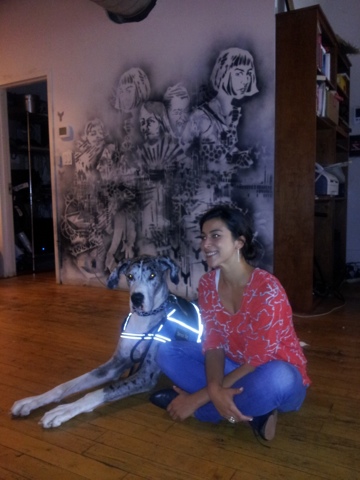
I have a service dog named Reykjavik, who for the last few years has been helping me cope with these two neurological disorders. Until recently, I had not been utilizing the full extent of his capabilities, because I was uncomfortable letting others know I had these disabilities. I did not tell anyone, and I never would have allowed Reykjavik to be thought of as a service dog, let alone wear any indication of such.
Now that I have decided to "come out" about all this, and embrace the use of a service dog, my world is changing dramatically. Today, Reykjavik and I took our second trip on the subway, from our home in Dumbo, into Manhattan. Riding the subway is a new skill for him, which he is learning rapidly. We are doing this once a week, for appointments and such.
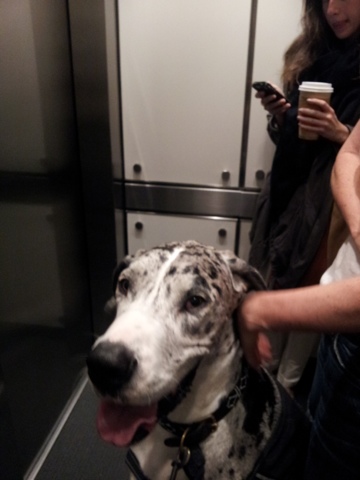
Today we went with our friend N, to visit her physical therapist in Soho. This is a place where I have gone (always alone) for 12-20 visits over a period of a couple months, for the last 2-3 years for my own physical therapy. It's a place I got lost in continually - a maze of twists and turns on each floor, common in these old buildings on Broadway. We dropped N off, and as soon we were out the door of the PT's office, Reykjavik without pause led us directly back to the correct elevator bank (N told me today that there was more than one. I did not realize this before today because no pathway ever looks familiar to me. I just assumed I had always been coming in the same way, but had not.) There was not one wrong turn or backtrack made, as per my usual route. We took the elevator down to the street(see picture of big dog in small elevator), exited the building and after some consideration on my part, turned right to enter a building 2-3 doors down where our good friend TBG had recently started working. I had promised her a visit. She had told me she worked on the 12th floor, so without looking for an office number we headed up in the elevator. We exited on the 12th floor, and I decided instead of texting her for suite number, I would just ask Reykjavik to find her. She is his godmother, so he knows her scent very well. This building was even more maze - like than the last, because the floor was bigger. Reykjavik started off one way, lost the scent, then turned around and headed back and right to her office. Once inside the big open room, which normally would have been a nightmare for me, with it's many desks and similar looking people, I just waited for him to find her, her to find him
(see picture of Reykjavik posing with a Flavorpill employee). So much less stress than normal. Once again when we left, he returned right to the elevator to head down. We walked to a shop not far away, with me using my phone's gps and google maps for directions (to a store I had been to numerous times before). When we left there, I asked him to "take me back", and he took me right to the same subway station we had exited upon our arrival, though via a slightly different route, instead of precisely retracing our steps.
We waited for N to finish her appointment, then went down in the station to catch the subway back to DUMBO.
And just like that, we were home. We had gone to visit two different offices, with no premapping, and almost no wrong turns, no wandering in the wrong hallway, no asking people for directions, most of all, no stress about getting lost or not recognizing someone! It was so freeing not to have to concentrate on every step and turn, to have a measure of ease and assurity while moving about with the dog to correct, lead, or return me. To be fair, in the beginning of the trip, we had N to lead us to the physical therapy office. What Reykjavik does best is "take me back" or "take me home". And that is all he did today. And these were all small difficulties that he aided me on. Yet to me, it's a glimpse into the life of a NT, or neurotypical person.
- Posted from somewhere near my dog
I took my dog out the other day for an afternoon walk. We went out the door and down the street, then turned left and headed toward our favorite park. As we came to the first intersection, I stopped to look for cars, and also took note of people approaching me from each direction, and whether they were attached to dogs or not.
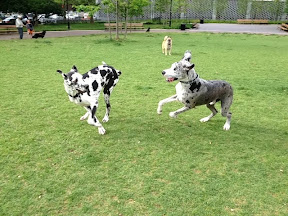
Just as I had finished checking everything out and headed across the street, a person a few feet away who I had noticed walking toward me, yelled my name and waved. It was our good friend N, on her way to the subway. I had looked right at her, and visually passed her by. Not unusual for me to not recognize someone, except, she was just a few yards from the door to her building, erasing one of my excuses, seeing some one out of context. Not only was it not out of context, but it was approximately where I meet her almost very morning, (this was afternoon) including this one, to walk our Great Danes together.
Now of all the people I expect to "recognize" N is one of those at the top of the list. She has a cool, distinctive style, and springy brunette coils of curls. This makes it 10 times more embarrassing for me not to recognize her. It creates the most awkward moment where I want to either profusely apologize or blend into the concrete of the sidewalk. Thankfully, N is very gracious and knows my problems probably better than most, so she just passes right over it. This is the blessing that comes from being open with people about Prosopagnosia.
In my defense, she did not have her Great Dane with her . . . - Posted from somewhere near my dog
Its an inside look into the life of someone with Prosopagnosia (me), created by Almudena Toral. I am pretty happy with how it turned out. Its all very true for me. I hope this gives people a little insight into the disorder.


![[IMAGE DESCRIPTION]](http://cdn.theatlantic.com/newsroom/img/posts/9091756566_b0a417d26c_c.jpg)